


On the morning of 1 September 1911, Athens and Piraeus awoke with their eyes turned towards the sea.
Somewhere beyond the horizon, Georgios Averof was approaching.
On its front page, the newspaper EMPROS announced the expected arrival of Averof at Phaleron that day, describing it as “the joyful event of a beautiful day”.
From early morning, people began making their way towards Phaleron. They came by electric railway and tram, by carriage and cart, by bicycle, and even on foot in the heat of the day.
In Kastella, the hillsides, rooftops and balconies filled with people. Young and old searched for a vantage point from which they could see the sea.
They were waiting for a ship.
Out at sea, the Squadron was already under way to meet her. The warships would enter Phaleron together, with Averof at their head.
Before long, the first silhouettes began to appear on the horizon.
First came the torpedo boats. Then Hydra, Spetsai and Psara. Among them, imposing and unmistakable, emerged Georgios Averof.
Then a simple, spontaneous cry rose from the crowd — a few words recorded by the newspaper and preserved for us to this day:
“There she is! There she is!”
Steamship whistles sounded across the water. Gun salutes echoed over the Saronic Gulf. The Navy band played the Greek National Anthem. Flags fluttered in the breeze and the crowds cheered.
At four o’clock in the afternoon, Averof dropped anchor at her designated position, five hundred metres off the New Phaleron landing stage.
Hundreds of boats and steam launches soon gathered around her, crowded with people. Cheers rose for the ship, her crew and her commanding officer, Pavlos Kountouriotis.
As daylight faded, the celebrations continued.
The Fleet was illuminated for the night. Lights traced the lines of Averof from bow to stern and rose high into her masts. Illuminated boats moved among the warships, while fireworks lit the sky above Phaleron.
This was how Greece welcomed her.
Today, it is worth pausing for a moment to think about the people who stood along those shores.
They were looking at a new warship, but in her they also saw a promise for the future. They saw the strength their country might acquire. They saw the men who had trained to serve aboard her. They saw a Navy preparing itself for whatever the future might bring.
None of those standing on the shore could have known what lay ahead.
Perhaps that is why the image of that day still speaks to us.
The strength of a warship does not lie in her steel, machinery and guns alone. It comes from the people who serve aboard her — from their knowledge, their training, their discipline, their trust in one another and their shared sense of purpose.
That was true in 1911. It remains true today.
Every young man and woman who steps aboard a warship for the first time becomes part of something that began long before them.
They inherit knowledge, experience, responsibility and a naval tradition that is not theirs to possess. Their country entrusts it to them for a time, so that they may carry it forward and, one day, pass it on to those who follow.
Perhaps that is something worth considering for young people today as they look towards the sea and wonder which path they will choose.
The Hellenic Navy needs people who love the sea, who want to learn, to work with others, to test their abilities and to take responsibility. People who can become part of a crew and understand that their own contribution gains its true value when it joins the efforts of those around them.
The sea teaches us quickly that no one sails alone.
Aboard a warship, technology meets knowledge, and knowledge is put into practice. Individual effort finds its purpose within a common mission. Young people learn to trust others and to become worthy of the trust placed in them.
That is where the strength of a crew lies.
And that is why Georgios Averof still has a purpose.
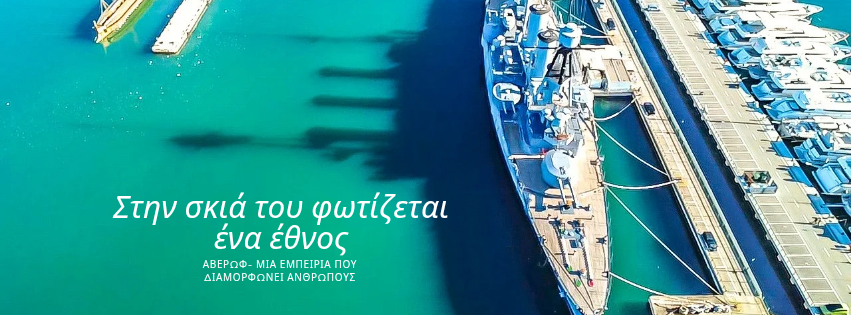
Today, she remains at Phaleron, keeping alive a remarkable continuity between generations: those who once walked her decks, those who serve in the Hellenic Navy today, and those who will one day put on the uniform for the first time and climb the gangway of their own ship.
More than a century ago, young men stood on the decks of Averof without knowing what History would soon ask of them.
They did what they had been trained to do.
And they left behind something that endured far beyond their own years of service.
Today, another generation of young men and women looks towards the sea and considers its own future.
Perhaps, for some of them, that future lies with the Hellenic Navy.
One hundred and fifteen years later, Georgios Averof remains in those same waters, still flying the Greek flag.
On 1 September 1911, thousands made their way to Phaleron to watch her arrive.
Today, we can walk her decks and consider what we, in turn, can pass on to those who will come after us.
For tradition is what we inherit, what we are called upon to serve, and what we pass on to the generations that follow.
Source: EMPROS, 1 and 2 September 1911.

